
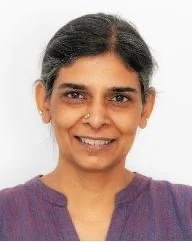
Annapurna Mamidipudi is a Fellow of Handloom Futures Trust, that supports research into handloom weaving as sustainable and resilient knowledge infrastructure, in Telangana and Board member of Timbaktu Collective, an organic farming collective in Andhra Pradesh, and Trustee of Malkha, a co-operative that works to link vulnerable cotton farmers and weavers through community owned spinning technologies. Her research interests focus on the study of how craftspeople innovate their material practices and how they make knowledge claims to build value for their work in past and contemporary society and markets. She is currently working on her own monograph based on the DFG funded project at Technical University Berlin, on “Epistemologies of craft: The role of material innovation in making colour expertise”.
Prior to her academic career, she trained as an engineer, after which she set up and ran an NGO Dastkar Andhra in South India to support craft weaver co-operatives towards sustainable production and consumption. She was an awardee of the Global Social Business Incubator program of Santa Clara University of 2009 for this work. She completed her doctoral work in the study of Science, Technology and Society Studies [STS] in 2016 titled ‘Towards a theory of innovation for handloom weavers in India’, supervised by Wiebe Bijker, at the University of Maastricht. As post-doctoral researcher in the Dutch MVI funded project on Responsible Research and Innovation in Biogas in India, she extended her theory of material innovation into vulnerable farming communities. In 2017, at the Max Planck Institute for the History of Science as a post-doctoral scholar she expanded her STS and History of Technology research on material histories of colour making in India to History of Science approaches. Alongside her post-doctoral position in the multi-disciplinary ERC project titled ‘Penelope: Weaving as technical mode of existence’ from 2019-21 at the Deutsches Museum, she co-edited a volume on Ownership of Knowledge: Beyond IP. In order to foster equal conversations between craftspeople and scholars, using the thesis as a base, she set up the Handloom Futures Research Collective in India which put together a seminar on Craft and Innovation in Chennai, India in 2016 putting craft practitioners and historians of science and technology in conversation. With the support of the Dutch classical research project ‘Anchoring Innovation’, the collective organized a large conference bringing together more than 500 weavers and international historians of technology and science in Chirala, India in 2018. During the COVID crisis of 20-21, their project to offer evidence-based policy recommendations for the handloom sector to the Textile Ministry of India, with the participation of weavers, through online conversations became a basis for a working group from India in MPIWG on Responsible Documentation. This group, formed across practitioners and scholars from Brazil, Papua New Guinea, India met at MPIWG in May 2022. In October 2024, the research collective brought dyers from India to interrogate the colour archives at the Dresden University. This trip was funded by the German Research Foundation DFG’s project, and a conference was held in Dresden, titled The Craft Origins of Colour and its Orderings. Along with the Making and Knowing project at Columbia University, an Indigo dyers conference is being planned in January 2027, to facilitate knowledge exchange between dyers and between academics and dyers.
Contact: annapurnam@gmail.com